Ports and waterways
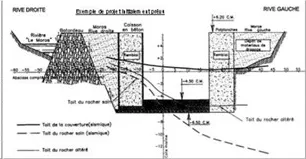
The project for a new dry dock at the commercial port of Concarneau consists of a dry dock measuring 130 m in length, 30 m in width and 11 m in depth. This structure is situated at the far end of the existing port, within the area of an silted-up artificial basin fed by a river with a moderate flow.
After channelling this watercourse, the project mainly involves dredging 6 to 8 m of submerged silt down to the bedrock. It was initially planned to carry out this dry earthworks behind cofferdams, then to construct the dry docks within this enclosed area before backfilling behind the retaining structures.
Following a review of the technical bids, it was decided to construct the dry dock using an enclosure of anchored diaphragm walls serving as the permanent cofferdams. As this method required prior treatment of the silt behind the walls, using preloading accelerated by vertical drains, it made it possible to limit the volume of silt excavated between the walls as well as the capacity of the pumping system. The management of excavated material was a key factor in the choice of construction method, as it was difficult to remove this silt via road through the city centre, or by sea in an area where dredging is permitted only far offshore. It should be noted that locally, blasting of the bedrock was planned in order to embed the base of the walls and level the rock rising rapidly on the left bank.
The stability of the excavation base in a dewatered caisson configuration is ensured by a drained raft foundation. One of the project’s challenges was to assess the stability and watertightness of the existing embankments downstream and upstream of the site.
The immediate proximity of fuel tanks for ships supplying the entire port of Concarneau, as well as buried pipelines, posed a major constraint on the rock blasting operations.
To prevent any damage to these structures, TERRASOL established vibration thresholds and provided recommendations regarding the rock extraction methodology. This advice led to the installation of a test panel in a low-risk area to optimise the blasting plans.
Project Manager
Finistère Departmental Public Works Directorate – Maritime Department
Client
Concarneau Chamber of Commerce and Industry
Miscellaneous
- Hold capacity: 40,000 m³
- Silt extraction: 25,000 m³
- Volume of backfill: 70,000 m³
- Diaphragm wall area: 4,700 m²
- Capacity of the drainage mat: 200 m³/h