Research projects
Innovating to advance the field.
PARTNERSHIPS – EXPERTISE – STANDARDS – ADVANCES
It is essential for terrasol to be involved in research projects to advance scientific and technological knowledge in the sector.
By collaborating with academic and industrial partners, these contributions aim to develop innovative methods and solutions tailored to the complex challenges of soils and infrastructure. This proactive approach not only enhances the quality of the expertise offered to clients but also contributes to the sustainable development of practices and standards in the field of geotechnics.
ASIRI +
Soil improvement and reinforcement using rigid inclusions subjected to complex loads.
Terrasol is actively involved in the ASIRI+ National Project, launched in 2019, which aims to extend the technique of reinforcement using rigid inclusions to structures subjected to complex loads. This new national project, chaired by Bruno Simon (scientific expert at Terrasol), builds on the lessons learnt from the ASIRI national project (2005–2011), which had focused primarily on embankments, slabs and footings subjected to static vertical loads, which were usually uniform.
The ASIRI+ project envisages several lines of research, notably the conduct of full-scale tests on foundations on rigid inclusions subjected to eccentric or inclined loading, which will provide Terrasol with an opportunity to experimentally evaluate the MV3/MH3 models implemented in our Foxta software suite. ASIRI+ also provides an opportunity to clarify the behaviour of massifs reinforced with inclusions when subjected to cyclic (wind turbine foundations), dynamic (railway context) and seismic loads.
It is in the seismic field that Terrasol is particularly positioning itself, with the funding of a PhD thesis co-supervised by the Institut Polytechnique de Paris (J.F. Semblat) and aimed at contributing to the understanding of the inertial and kinematic interaction mechanisms that govern the seismic response of a massif reinforced with rigid inclusions. The aim of this PhD research is to develop a design tool that combines simplicity and robustness (in the form of a dynamic macro-element) and provides a solution tailored to the practical needs of engineers.
ARSCOP

The pressure meter: a device for soil investigation and the design of geotechnical structures.
terrasol is actively contributing to the national ARSCOP project, launched in 2016 and dedicated to pressometer engineering under the auspices of IREX (Institute for Applied Research and Experimentation in Civil Engineering).
This project brings together the entire geotechnical profession and has two main objectives: to continue developing the cone penetrometer and its use in studies to improve the design of geotechnical structures, and to promote the cone penetrometer and associated design methods internationally. Terrasol’s contribution to this project has enabled the development of a new unified approach for the design of raft foundations and footings based on the pressuremeter. The approach developed, whilst accounting for the non-linear behaviour of soils, is intended to be simple and easy to implement. Its use can be extended to complex calculations employing hybrid methods (in a TASPLAQ-type model from the Foxta software suite) or numerical methods (finite element methods, for example).
RUFEX
Reuse of Existing Foundations
This research project, accredited by the Advancity Competitiveness Cluster in 2009, was completed in 2014 after four years of intense and fruitful work. terrasol, alongside various companies, universities and project owners (Solétanche-Bachy, SNCF, LCPC, INSA-Lyon, CERMES), carried out innovative developments.Dedicated to the reuse of existing foundations from buildings, engineering structures or railway platforms for the purpose of infrastructure rehabilitation, using the Soil Mixing process, this project has led to the development of tools and methodologies for both implementation and calculation. terrasol has thus been able to extend the capabilities of its Foxta software to model the effect of reinforcing these columns beneath railway tracks as well as existing foundations, whether shallow or deep. The results were presented at the International Congress on Soil Mechanics and Geotechnics held in Paris in 2013.
PN SOLCYP

Behaviour of piles subjected to cyclic loading
This four-year project (2008–2012) was led by IREX (Institute for Experimental Research in Civil Engineering) and funded by the RGCU. Its objectives were to understand the physical phenomena governing the response of piles subjected to cyclic vertical or horizontal loads, and to quantify the effect of cyclic loading on the response and capacity of piles.
Based on a methodology for analysing the behaviour of piles subjected to cyclic loads, the aim was to develop engineering methods whose complexity of implementation would remain compatible with the nature of the structures and the severity of the cyclic effects. This project aimed to produce pre-standardisation work with a view to incorporating the proposed methodology and associated calculation methods into national regulations.
ASIRI NATIONAL PROJECT
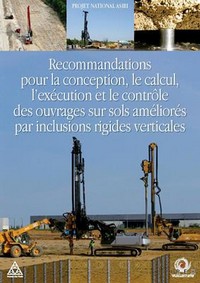
Soil Improvement Using Rigid Inclusions
The aim of this project was to gain a better understanding of the mechanisms involved in strengthening foundation soils using rigid inclusions. The project began in 2005 and ran for five years; Bruno Simon, Scientific Director of Terrasol, chaired the project’s Scientific and Technical Committee. The project brought together more than forty partners from industry and academia and served as the basis for nine PhD theses. Comparing data from monitoring of experimental sites, real-world sites and physical models in test chambers and centrifuges with the results of calculations carried out using a variety of numerical approaches made it possible to identify the key characteristics of the behaviour of these structures and refine the numerical models. This work culminated in the publication of ‘Recommendations concerning the construction and design of embankments and slabs on ground reinforced with rigid inclusions’.
National Microtunnels Project
This project, led by the FSTT and IREX, with Alain Guilloux serving as Technical Director, ran from 1993 to 2002. Its aim was to develop multidisciplinary research in the field of ‘trenchless works’, microtunnelling and directional drilling, to gain a better understanding of these techniques and adapt them to the specific conditions in France. This research focused both on fundamental aspects (field measurements, modelling and laboratory studies) and on technological considerations (materials used, monitoring of drilling parameters, etc.). The socio-economic dimension was also addressed by proposing an assessment of social costs. This project brought together project managers, design consultancies, contractors and suppliers. The synthesis of the research led to the publication of two volumes of recommendations in 2002.
National Forever Project
Vertically Reinforced Foundations
This project, to which François Schlosser of terrasol also made a significant contribution, ran from 1993 to 2001. It focused on the reinforcement of foundation soils using micropiles, examining both the behaviour of an individual micropile and that of groups or networks of micropiles, and included, in addition to a review of the current state of knowledge and a technical-economic study, laboratory tests (in a calibration chamber and in a centrifuge), field tests, theoretical modelling, and the development of calculation methods.
This project led to the publication of recommendations in 2004.
Clouterre National Research Project
Soil reinforcement by piling
Research and study activities were carried out between 1986 and 1990 as a joint initiative of the Ministry of Infrastructure, the National Federation of Public Works and IREX. François Schlosser, founder of terrasol, chaired this research project, to which Alain Guilloux and Bruno Simon also contributed. This work led to the publication of the Clouterre 1991 recommendations, which cover all aspects of soil nailing used in retaining structures.
This project was followed by a second phase in the late 1990s, the aim of which was to monitor the implementation of the Clouterre 1991 recommendations and to supplement them with a better understanding of the behaviour of the structures, which led to the publication of the Addendum 2002 recommendations.