The project
Dynamic Seismic Analysis and Overall Stability Verification during the Preliminary Design Phase
As part of the preliminary design studies for the DFG Résines building, located at the La Hague nuclear waste treatment plant, an analysis of its seismic resistance is required.
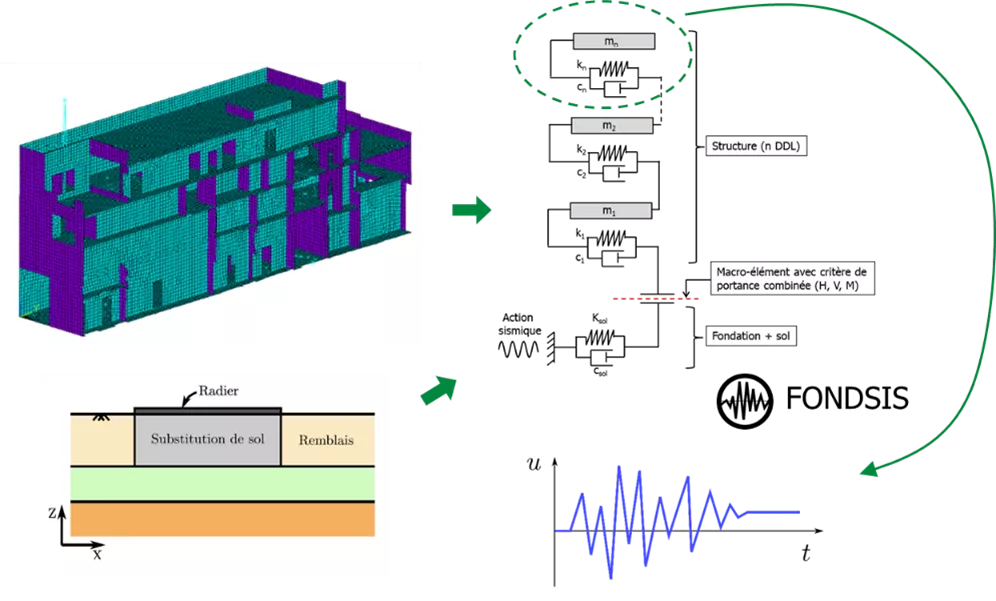
The DFG Résines building is a rectangular reinforced concrete structure measuring 14 m x 49 m. It is founded on a general raft foundation resting on a soil replacement made of lean concrete/RAC down to bedrock.
Terrasol’s remit: to evaluate the dynamic impedance functions required for the seismic calculations of the structure and to verify its stability under a core-seismic event using a displacement-based approach.
The dynamic impedance functions were established using a SASSI2010 hybrid model with explicit modelling of the soil replacement using volumetric elements. In parallel, a study of the impact of soil substitution modelling on the calculation of impedance functions was carried out, revealing that modelling soil substitution as a horizontal soil layer (of implicitly infinite width) generates an excessively high apparent flexural/shear stiffness of the foundation.
The seismic stability of the building was verified using the FONDSIS software, developed at terrasol for the analysis of non-linear dynamic soil-structure interaction (SSI) problems. A parametric study was carried out, including, amongst other things, an increase in loading and a reduction in strength properties, which enabled an unambiguous conclusion to be reached regarding the seismic stability of the structure.
Key points
- Non-linear ISS with macro-element (Fondsis)
- Seismic stability of the core
- Soil substitution